Home > Search Results
Search Results
Your search for ttp returned 1 category and 34 items
Categories
Items
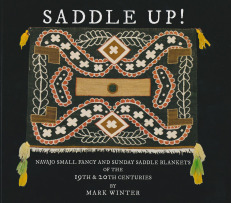
A must-have for every weaving library is Saddle Up! by Mark Winter. This new and exciting publication features Navajo Fancy and Sunday saddle blankets from the 1860’s to 2011, representing six to eight generations of weaving creativity. Included are over 100 color plates and insightful text. Accompanying the book is Saddle Up! Side Kick, a flipbook of the color plates included in the main book. The pair sells for $48 plus shipping.
Most of the saddle blankets in the book are on display at the Toadlena Trading Post Weaving Museum. Come see the exhibition after enjoying the Saddle Up! catalog.
Most of the saddle blankets in the book are on display at the Toadlena Trading Post Weaving Museum. Come see the exhibition after enjoying the Saddle Up! catalog.
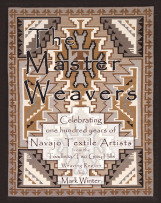
The Master Weavers details many of the best textiles, their weavers and families of the Toadlena/Two Grey Hills region since its beginnings in the early 20th century. It is 608 pages, contains 250 color plates, over 450 historic and contemporary photographs and 23 extensive genealogies of 87 Master Weavers including 2 Legendary Master Weavers, Daisy Taugelchee and Bessie Manygoats.
Published in 2011, The Master Weavers is now a standard for excellence in research of Navajo weavings and culture.
Published in 2011, The Master Weavers is now a standard for excellence in research of Navajo weavings and culture.
Navajo Rugs & Weavings > $1,000 - $2,500
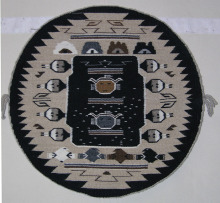
Master Weaver Mary H. Yazzie
This rug measures 24" in diameter and depicts the "Night Sky" sand painting. It is a wonderful piece of Navajo mythology.
Navajo Rugs & Weavings > $2,501 - $5,000
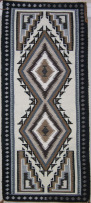
N-4599 Rose Blueeyes
This rug measures 21" x 49".
The high contrast and strong serration make this a very good weaving and one of the best runners we have seen.
The high contrast and strong serration make this a very good weaving and one of the best runners we have seen.
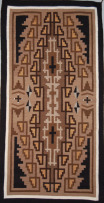
This rug measures 23" x 45" by Master Weaver Marie Lapahie. She frequently weaves more expensive tapestries so the piece offers a good opportunity to acquire one of Marie's fine weavings a price lower than that of a tapestry.
Navajo Rugs & Weavings > $201 - $500
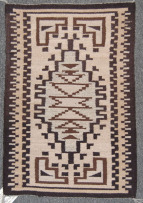
Navajo Rugs & Weavings > $5,000 and Up
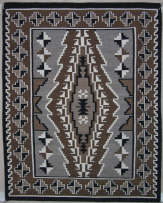
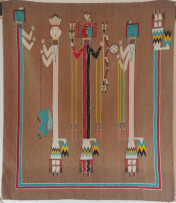
Master Weaver Ruby Manuelito, Sandpainting
This piece measures 26" x 30", hand-spun yarn, 6 colors, natural white and brown, all other colors are hand-dyed aniline, c. 1980's, excellent condition.
Master Weaver Ruby Manuelito was the daughter of Master Weaver Frances Manuelito and the granddaughter of Master Weaver Blind Man's Wife. Blind Man's Wife was a true pioneer in the evolving designs of early, regional Navajo rugs. Thus, were Ruby's feet placed on her own artistic journey by these earliest influences. Ruby married Ira Manuelito and became the daughter-in-law of Gladys Manuelito, "Mrs. Sam", the niece of Hastiin Klah. Klah was the first Navajo Medicine Man to render a Sandpainting image in a permanent form, woven wool. She learned the Sandpainting images forms from Gladys as Gladys learned them from Klah, putting her very near the epicenter of Sandpainting weaving.
This piece bears images of the Navajo Holy People from the same Nightway Chant image woven by Ruby that appears on p. 228, Plate 71 of "The Master Weavers" by Mark Winter. It has 68-74 wefts per inch and 14 warps per inch.
Ruby's finely woven sandpainting are difficult to find and highly prized. We hope you enjoy this treasured piece of Navajo mythology as much as we do!
Master Weaver Ruby Manuelito was the daughter of Master Weaver Frances Manuelito and the granddaughter of Master Weaver Blind Man's Wife. Blind Man's Wife was a true pioneer in the evolving designs of early, regional Navajo rugs. Thus, were Ruby's feet placed on her own artistic journey by these earliest influences. Ruby married Ira Manuelito and became the daughter-in-law of Gladys Manuelito, "Mrs. Sam", the niece of Hastiin Klah. Klah was the first Navajo Medicine Man to render a Sandpainting image in a permanent form, woven wool. She learned the Sandpainting images forms from Gladys as Gladys learned them from Klah, putting her very near the epicenter of Sandpainting weaving.
This piece bears images of the Navajo Holy People from the same Nightway Chant image woven by Ruby that appears on p. 228, Plate 71 of "The Master Weavers" by Mark Winter. It has 68-74 wefts per inch and 14 warps per inch.
Ruby's finely woven sandpainting are difficult to find and highly prized. We hope you enjoy this treasured piece of Navajo mythology as much as we do!
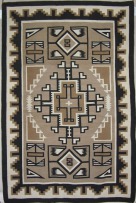
Sleepy Rock Clan, c. 1940's
SOLD
This 3 column rug measures 44" x 69", excellent condition, c. 1940's,
weaver unknown. We were not able to pin this down to a
specific weaver but she sure did a great job!
This 3 column rug measures 44" x 69", excellent condition, c. 1940's,
weaver unknown. We were not able to pin this down to a
specific weaver but she sure did a great job!
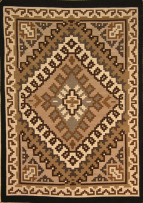
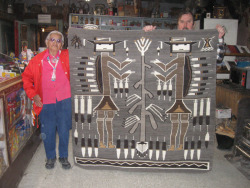
This sandpainting rug measures 60" x 61", all natural, hand-spun yarn by Master Weaver Mary Ann Foster.
Master Weaver Mary Ann Foster belongs in the elite group of Navajo sandpainting weavers. This includes Haastin Klah, Gladys Manuelito (Mrs. Sam), Mrs. King Tut and more.
Mary Ann has faithfully rendered traditional Navajo sandpainting images and her own creations. This creation by Mary Ann features a central corn stalk, the Navajo Tree of Life, flanked by two Humpback Fringe Mouth Yeis. The accoutrements and other elements are common to Navajo sandpaintings. The Toadlena Trading Post always looks forward to pieces by these living treasures.
Mary Ann and her Clan appear in Chapter 5:5, p. 200 of "The Master Weavers."
Master Weaver Mary Ann Foster belongs in the elite group of Navajo sandpainting weavers. This includes Haastin Klah, Gladys Manuelito (Mrs. Sam), Mrs. King Tut and more.
Mary Ann has faithfully rendered traditional Navajo sandpainting images and her own creations. This creation by Mary Ann features a central corn stalk, the Navajo Tree of Life, flanked by two Humpback Fringe Mouth Yeis. The accoutrements and other elements are common to Navajo sandpaintings. The Toadlena Trading Post always looks forward to pieces by these living treasures.
Mary Ann and her Clan appear in Chapter 5:5, p. 200 of "The Master Weavers."
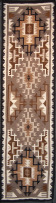
N-4011 Master Weaver Daisy Shorty
Several years ago the Post began encouraging the weavers to weave "runners" to supply an under attended demand. It took them a while to accommodate the new configuration. This piece by Daisy Shorty is one of the finest we have seen.
Daisy, her Clan and this specific piece appear in Chapter 5:19, p. 478. This runner is on p. 493, Plate 218.
Daisy, her Clan and this specific piece appear in Chapter 5:19, p. 478. This runner is on p. 493, Plate 218.
SOLD
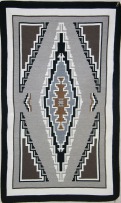
This tapestry measures 35" x 56", handspun yarn, overdyed black, all other colors are natural, c. 1980's, excellent condition.
Master Weaver Julia Jumbo wove this 120 weft per inch masterpiece. It is the largest tapestry we have seen that Julia wove. The uncluttered simplicity gives the piece artistic strength and the fineness of 120 WPI on this scale create a gravitas when seen in person. The hand-carded colors are quite luscious! Her weaving heyday was the same time that the finest Navajo weavings began to jump off of the floor and on to the wall.
Julia was one of the Grandma's we had the honor and pleasure of spending many years with.
A photo of the tapestry is shown horizontally because the long single-diamond lends itself to that orientation.
Arizona Highways, July 1974 states: "Daisy Taugelchee is the 'Grand Dame' of two Grey hills weavers. As pacesetter of the tapestry medium Daisy's looms have produced more top award winners than any other weaver. The attrition of age and cataracts may cause an involuntary abdication of the Two Grey Hills longest lived queen. The area is especially noted for the number of superior weavers, with Julia Jumbo currently the setting the pace."
This tapestry measures 35" x 56", handspun yarn, overdyed black, all other colors are natural, c. 1980's, excellent condition.
Master Weaver Julia Jumbo wove this 120 weft per inch masterpiece. It is the largest tapestry we have seen that Julia wove. The uncluttered simplicity gives the piece artistic strength and the fineness of 120 WPI on this scale create a gravitas when seen in person. The hand-carded colors are quite luscious! Her weaving heyday was the same time that the finest Navajo weavings began to jump off of the floor and on to the wall.
Julia was one of the Grandma's we had the honor and pleasure of spending many years with.
A photo of the tapestry is shown horizontally because the long single-diamond lends itself to that orientation.
Arizona Highways, July 1974 states: "Daisy Taugelchee is the 'Grand Dame' of two Grey hills weavers. As pacesetter of the tapestry medium Daisy's looms have produced more top award winners than any other weaver. The attrition of age and cataracts may cause an involuntary abdication of the Two Grey Hills longest lived queen. The area is especially noted for the number of superior weavers, with Julia Jumbo currently the setting the pace."
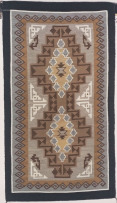
SOLD
This piece measures 25" x 45" with 9 colors by Master Weaver Salina Dale.
Salina brought this piece in the weekend of "Eye on the Storm." It is always a thrill to a new piece!
Salina Dale is the best colorist we have seen. This piece features her distinctive blue/grey and gold yarn. The border has looping, inter-locking claws. She orchestrates her lighter and darker colors to accent various elements of the double diamond layout.
A new piece by any of the Maser Weavers is a treat!
This piece measures 25" x 45" with 9 colors by Master Weaver Salina Dale.
Salina brought this piece in the weekend of "Eye on the Storm." It is always a thrill to a new piece!
Salina Dale is the best colorist we have seen. This piece features her distinctive blue/grey and gold yarn. The border has looping, inter-locking claws. She orchestrates her lighter and darker colors to accent various elements of the double diamond layout.
A new piece by any of the Maser Weavers is a treat!
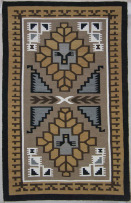
This rug measures 36" x 57", excellent condition, by Master Weaver Evelyn George.
This rug displays the simple elegance that it Evelyn at her best. It was woven 6 years ago and came back around to us. We are thrilled to see it again!
This rug displays the simple elegance that it Evelyn at her best. It was woven 6 years ago and came back around to us. We are thrilled to see it again!
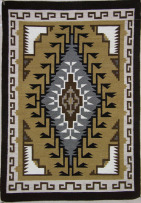
This rug measures 32" x 46". It was woven by Master Weaver Emily Watchman. Emily is a member of 3 generations of Master Weavers who include her Mother, Evelyn George, her sister, Dorothy Lowe and her daughter, Stacy Watchman.
This rug displays her Mother's gold and gray wool and bears similarities to her Mother's style. It is a real joy to see new work from The Master Weavers!
This rug displays her Mother's gold and gray wool and bears similarities to her Mother's style. It is a real joy to see new work from The Master Weavers!
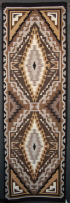
N-6258 Barbara Tsosie
This rug measures 24" x 75".
The Toadlena Post has encouraged the weavers to produce runners. The long, skinny configuration was a challenge for some for a while. Here is evidence that Barbara has adapted very well!
The Toadlena Post has encouraged the weavers to produce runners. The long, skinny configuration was a challenge for some for a while. Here is evidence that Barbara has adapted very well!
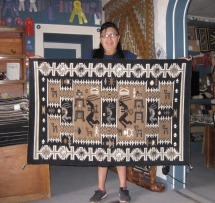
N-7710 Lovita Etcitty
Woven by Lovita Etcitty, Tachini i clan of Sanostee, who is the oldest daughter of Master Weaver Esther Etcitty, the long-time weaver of rugs containing images of Anasazi and Navajo rock art. Lovita was slow to adopt her mother’s style but managed to do a small number of handspun masterpieces, such as this one, before she was killed by a hit and run driver in a crosswalk in downtown Farmington, NM.
Navajo Rugs & Weavings > $501 - $1,000
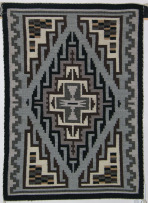
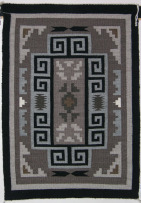
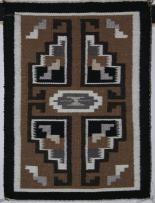
Master Weaver Pamela Brown, N-7634
SOLD
The quadrated diamond is a design made famous in the 1910's by her Grandmother, Master Weaver Blind Man's Wife.
16" x 22"
The quadrated diamond is a design made famous in the 1910's by her Grandmother, Master Weaver Blind Man's Wife.
16" x 22"